


Page 8 - Ärzteblatt Mecklenburg-Vorpommern, Oktober 2026
P. 8
WISSENSCHAFT UND FORSCHUNG


           Auf dieser Plattform ließen sich mehrere Messprinzipien rea-  In-vivo-Ischämiedetektion mittels
           lisieren: Elektroden zur Impedanzmessung, Temperatursen-  Bioimpedanz [6]
           soren mit reproduzierbarem Signalverhalten im physiologisch
           relevanten Bereich zwischen 24 °C und 49 °C sowie Bauele-  Den Abschluss bildete die erste In-vivo-Anwendung dieses
           mente für die chemische Sensorik, etwa zur pH-Messung. [11].  intraanastomosären organischen Bioimpedanzsensors zum


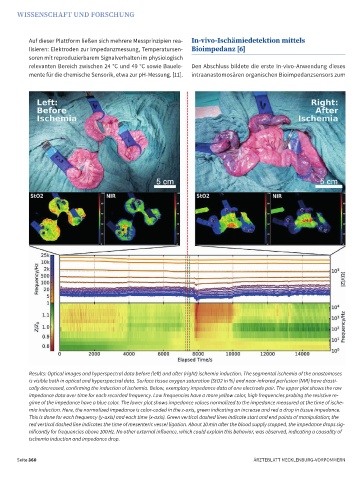
           Results: Optical images and hyperspectral data before (left) and after (right) ischemia induction. The segmental ischemia of the anastomoses
           is visible both in optical and hyperspectral data. Surface tissue oxygen saturation (StO2 in %) and near-infrared perfusion (NIR) have drasti-
           cally decreased, confirming the induction of ischemia. Below, exemplary impedance data of one electrode pair. The upper plot shows the raw
           impedance data over time for each recorded frequency. Low frequencies have a more yellow color, high frequencies probing the resistive re-
           gime of the impedance have a blue color. The lower plot shows impedance values normalized to the impedance measured at the time of ische-
           mia induction. Here, the normalized impedance is color-coded in the z-axis, green indicating an increase and red a drop in tissue impedance.
           This is done for each frequency (y-axis) and each time (x-axis). Green vertical dashed lines indicate start and end points of manipulation; the
           red vertical dashed line indicates the time of mesenteric vessel ligation. About 10 min after the blood supply stopped, the impedance drops sig-
           nificantly for frequencies above 100 Hz. No other external influence, which could explain this behavior, was observed, indicating a causality of
           ischemia induction and impedance drop.


       Seite 360                                                                     ÄRZTEBLATT MECKLENBURG-VORPOMMERN

